Why Sleeping Less During Perimenopause May Be Damaging Your Mitochondria

Most articles about weight gain during perimenopause focus on familiar explanations: declining estrogen, a slower metabolism, loss of muscle mass, and increased abdominal fat.
All of these factors matter.
But there is a deeper biological story unfolding beneath the surface—one that connects estrogen, sleep, mitochondria, and metabolic efficiency.
What if weight gain during perimenopause is not simply a hormonal issue?
What if it is, at least in part, an energy-production problem occurring inside every cell of the body?
Perimenopause Doesn't Start in the Waistline. It Starts in the Cell.
Every cell in the body contains mitochondria, tiny structures responsible for converting nutrients into ATP, the energy currency that powers human life.
For decades, mitochondria were viewed primarily as cellular power plants. Today, researchers understand that they influence far more than energy production. They help regulate:
Metabolism
Insulin sensitivity
Inflammation
Oxidative stress
Appetite regulation
Circadian rhythms
Sleep quality
What many women do not realize is that estrogen plays an important role in supporting mitochondrial health.
As estrogen levels begin fluctuating during perimenopause, mitochondria may lose some of that protective support. Over time, they can become less efficient at generating energy and more vulnerable to oxidative stress.
This shift may have consequences that extend far beyond reproductive health.
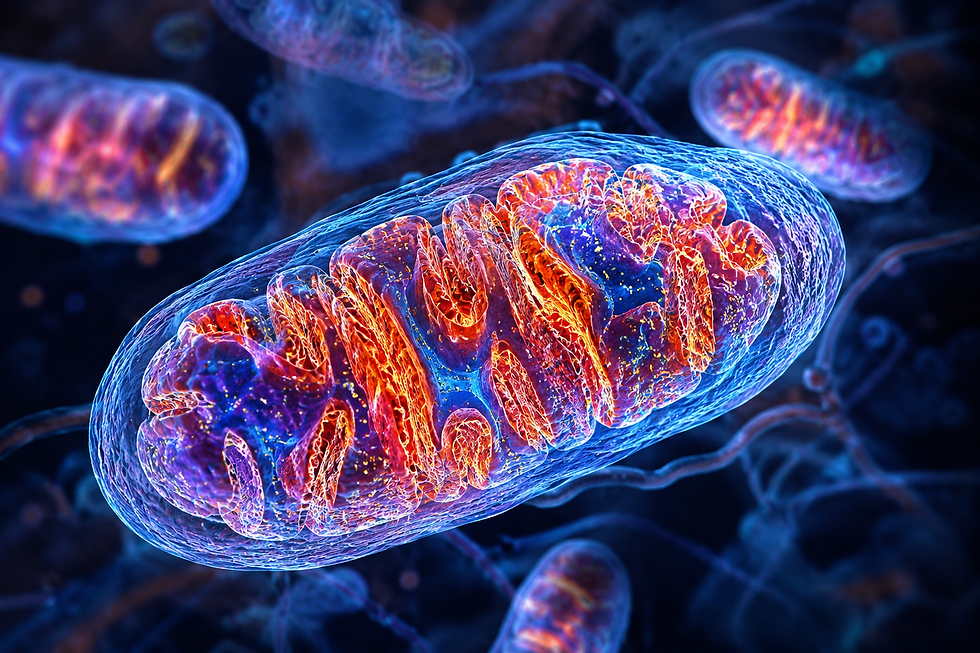
The Missing Link: How Poor Sleep Impacts Mitochondrial Function
Most people think of sleep deprivation as a cause of fatigue.
The reality appears to be much more profound.
Emerging research suggests that insufficient sleep can directly affect mitochondrial function, influencing:
ATP production
Cellular energy efficiency
Oxidative stress levels
Mitochondrial repair mechanisms
Metabolic flexibility
In other words, a poor night's sleep doesn't simply make you tired the next day.
It may temporarily reduce your cells' ability to produce energy efficiently.
Now imagine this process repeating night after night throughout the years of perimenopause.
The Silent Metabolic Spiral
Many women entering perimenopause describe a frustrating experience:
"I feel exhausted all the time, yet I keep gaining weight."
This may not be a coincidence.
When mitochondria become less efficient, the body can enter a state that resembles an internal energy shortage—even when calorie intake is adequate.
1. The Brain Detects an Energy Deficit
The brain is highly sensitive to energy availability.
When cells struggle to produce energy efficiently, the brain may interpret the situation as a need for additional fuel.
The result can include:
Increased hunger
More frequent cravings
A stronger desire for sugary foods
Greater reliance on refined carbohydrates
This isn't necessarily a matter of willpower.
It may represent the body's attempt to solve what it perceives as an energy problem.
2. The Body Conserves Energy
Fatigue naturally changes behavior.
Women experiencing persistent sleep disruption often find themselves:
Moving less throughout the day
Exercising less frequently
Taking fewer walks
Engaging in less spontaneous physical activity
This reduction in daily movement lowers overall energy expenditure, even if formal exercise habits remain unchanged.
3. Abdominal Fat Becomes More Likely
Poor sleep is associated with elevated cortisol levels.
Chronically elevated cortisol can contribute to:
Increased insulin resistance
Greater fat storage around the abdomen
Heightened inflammation
Reduced metabolic efficiency
Over time, a self-reinforcing cycle may emerge:
Less sleep leads to lower cellular energy production.
Lower energy production leads to more fatigue.
More fatigue encourages less movement.
Less movement contributes to weight gain.
Weight gain can further disrupt sleep quality.
And the cycle continues.
The Unique Vulnerability of the Female Brain
The female brain is one of the body's most energy-demanding organs.
Estrogen helps support communication between neurons and the mitochondria that fuel them.
As hormonal fluctuations intensify during perimenopause, this relationship may become less efficient.
This could help explain why many women report:
Brain fog
Difficulty concentrating
Memory lapses
Mental fatigue
Mood changes
These experiences are often dismissed as unavoidable symptoms of aging.
However, they may reflect meaningful changes in cellular energy production within the brain itself.
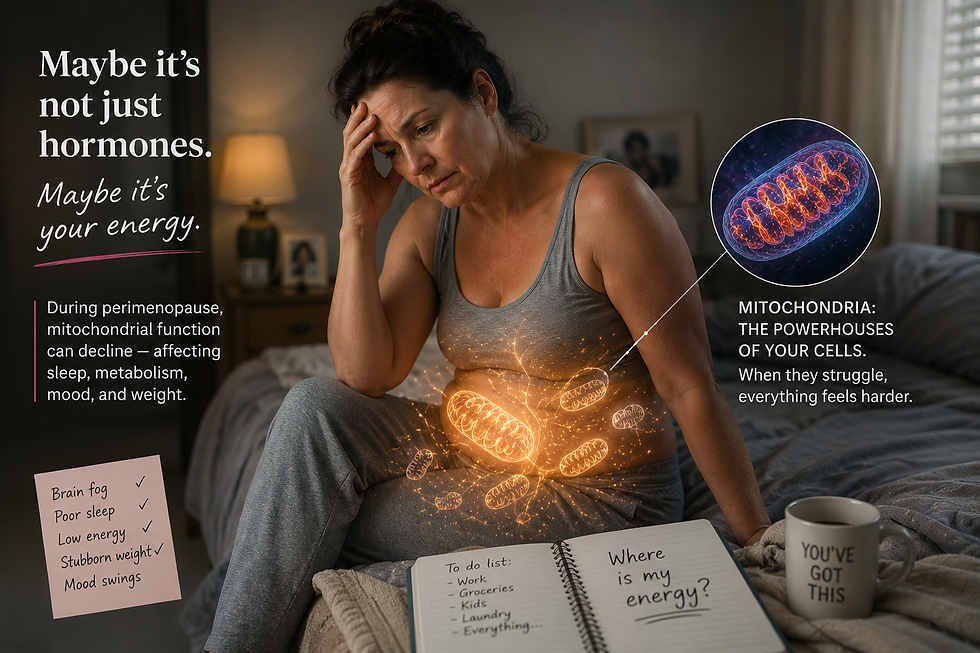
Could Weight Gain Be a Marker of Reduced Energy Efficiency?
This perspective challenges the conventional narrative surrounding perimenopausal weight gain.
Rather than viewing excess weight solely as the consequence of eating more and moving less, it may be useful to consider a deeper biological question:
How efficiently is the body producing and using energy?
When ATP production becomes less efficient:
Fat oxidation may decline
Recovery becomes slower
Physical performance decreases
Energy levels fall
Metabolic flexibility is reduced
Weight gain may be one visible outcome of this broader shift in cellular function.
What This Means for Women in Perimenopause
If mitochondrial health plays a meaningful role in perimenopausal weight changes, focusing exclusively on calorie restriction may miss an important part of the picture.
Supporting energy production at the cellular level becomes equally important.
Prioritize Deep, Restorative Sleep
Sleep is one of the most powerful regulators of mitochondrial health.
Improving sleep quality may help restore metabolic resilience, support appetite regulation, and improve energy levels.
Preserve Muscle Through Resistance Training
Muscle tissue contains large numbers of mitochondria and plays a critical role in metabolic health.
Strength training can help stimulate mitochondrial renewal while preserving lean muscle mass.
Support Circadian Rhythm
Morning sunlight exposure, consistent sleep schedules, and healthy light-dark cycles help regulate both mitochondrial activity and hormone balance.
Emphasize Nutrient-Dense Foods
Protein-rich meals, colorful vegetables, omega-3 fatty acids, and polyphenol-rich foods may help support cellular energy production while reducing inflammation.
A New Way to Think About Perimenopausal Weight Gain
For years, the conversation around weight gain in perimenopause has centered almost entirely on hormones.
Hormones certainly matter. But hormones do not operate in isolation. Estrogen influences mitochondrial function.
Mitochondria influence sleep. Sleep influences metabolism. And metabolism influences body weight.
Perhaps the most important question is not: "Why am I gaining weight?"
But rather:
"Are my cells producing energy as efficiently as they once did?"
Viewing perimenopause through the lens of cellular energy offers a more comprehensive understanding of what many women experience during this transition.
It reframes perimenopause not merely as a hormonal shift, but as a profound reorganization of the body's energy economy—one that begins deep within the cell long before it appears on the scale.
Could Supporting Your Mitochondria Be the Missing Piece During Perimenopause?
Support Your Mitochondria. Support Your Energy.
Learn why thousands of adults are exploring mitochondrial support for healthy aging and vitality.
Many women focus exclusively on hormones during perimenopause. But emerging research suggests that cellular energy production may also play an important role in how women experience fatigue, poor sleep, brain fog, and changes in metabolism.
That's why I became interested in mitochondrial health.
Advanced Mitochondrial Formula was designed to support the body's natural energy-producing systems with ingredients commonly associated with mitochondrial function, including CoQ10, PQQ, Acetyl-L-Carnitine, Alpha-Lipoic Acid, Niacinamide, and Magnesium.
While no supplement can replace healthy sleep, nutrition, movement, and medical care, supporting your mitochondria may be one additional strategy worth exploring if you're navigating the challenges of perimenopause.
Because sometimes the issue isn't simply aging.
Sometimes it's how efficiently your cells are producing energy.
Learn more about Advanced Mitochondrial Formula and see whether mitochondrial support could be right for you.
Could Your Cells Be Asking for More Support?
If you're experiencing fatigue, poor sleep, low motivation, or changes in metabolism during perimenopause, supporting mitochondrial health may be worth exploring.



Comentários